
Built on the old bed of Lake Agassiz
Concrete Contractors in Fargo, ND
Driveways, patios, walks and slabs poured for heavy clay, 51 inches of snow a season and a long freeze.
- Free on-site estimates with a base and drainage check
- Itemized written quote before any work begins
- Air-entrained mixes and planned control joints on every exterior pour
Concrete That Has to Survive a Fargo Year
Fargo is the center of our service area, and the concrete contractors work we do here starts with the ground under it. Fargo sits on the west bank of the Red River in a valley left flat by glacial Lake Agassiz, which drained about 9,300 years ago. The lake left behind clay that is rich for farming and weak for building. Every driveway, patio, sidewalk and garage slab in town rests on that clay, so the base and the drainage matter as much as the concrete itself.
What the clay does to a slab
The North Dakota Geological Survey describes the Brenna Formation clay under Fargo and West Fargo as soft and expansive, and about 70 feet thick in the Fargo area. Clay like that swells when it gets wet and shrinks as it dries. A slab poured straight on top of it, with no real base, rides those changes and cracks. That is why so many older Fargo driveways have one panel tipped toward the house or a walk with a heaved joint.
Our answer is not complicated, but it takes time to do right:
- Dig out soft or organic soil and replace it with compacted granular base, not loose fill.
- Slope every slab away from the house so roof and snowmelt water does not soak the clay at the foundation.
- Place control joints close enough together that the slab cracks where we want it to, in a straight line.
- Use steel where the load calls for it, such as the apron of a driveway where trucks turn.
Winter is the real test
Fargo's January normal mean temperature is 9.2 degrees, and the city averages about 43 days a year at or below zero. Average snowfall is 51.4 inches a season. All of that means freeze-thaw cycles, plows, shovels and deicer. We order air-entrained concrete for outdoor work, because the tiny air bubbles give freezing water room to expand without spalling the surface. We also tell every customer to skip deicing salt on new concrete for the first winter and to never use products with ammonium nitrate or ammonium sulfate.
The freeze shapes the calendar, too. The usual last freeze in spring is around May 8 and the first in fall is around September 30. Concrete can be poured outside that window with blankets and heated water, but we never place it on frozen ground.
Old north side, new south side
Fargo's housing changes a lot from one end of town to the other. The city's Horace Mann neighborhood profile lists a median build year of 1927 for owner-occupied homes, and many of those lots still have narrow single-car driveways, old stepped walks and detached garages on aging slabs. Those homes usually need concrete repair and replacement, new sidewalks and steps, or a garage slab that finally sits level.
Since the mid-1980s, most of Fargo's residential growth has gone south and southwest. The Centennial neighborhood was annexed between 1989 and 1995 and has a median owner home year of 1997. Homes there are often ready for a wider driveway, a backyard patio or a stamped concrete upgrade on a plain builder slab.
City sidewalks have their own rules
The City of Fargo's sidewalk FAQ says state law requires property owners to install and maintain sidewalk next to their property in the city right-of-way. The same page says anyone installing or repairing that sidewalk must be licensed with the City of Fargo as a Sidewalk Contractor and hold a North Dakota general contractor's license, and that unauthorized work can be fined. Sidewalks and approaches are both covered by that ordinance. Concrete on your own lot, behind the public walk, is a separate matter, and we tell you which side of that line each part of your project falls on.
Driveway width is set by the Engineering Department too. Residential driveways must be at least 9 feet and no more than 30 feet wide at the sidewalk line, unless the City Engineer approves more. We plan new and widened driveways around those numbers from the first visit.
What we pour in Fargo
- Concrete driveways sized to city rules, with a thickened apron at the street
- Concrete patios that slope to the yard, not to the foundation
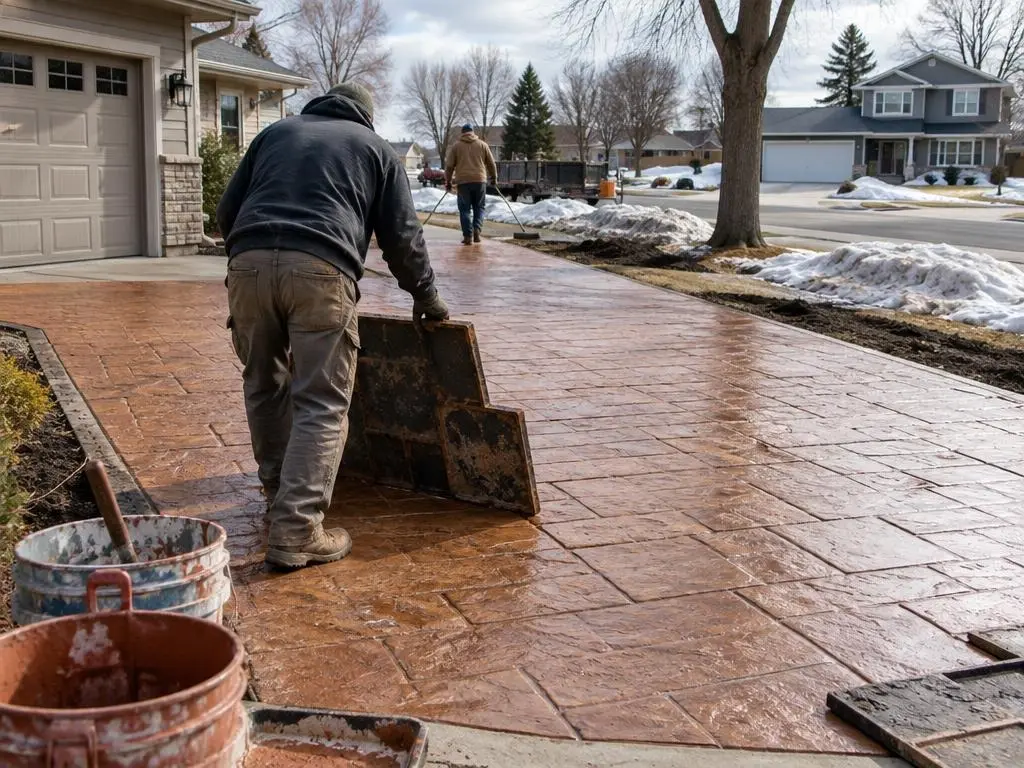
- Stamped concrete for patios and front walks, sealed for freeze-thaw
- Sidewalks and steps for front entries and city walks
- Garage and shed slabs with a compacted base and proper joints
- Concrete repair and replacement for sunken, cracked or heaved panels
Fargo Facts That Shape Concrete Work
- Soil. The Brenna Formation clay under Fargo is soft and expansive and about 70 feet thick, per the ND Geological Survey.
- Winter. January's normal mean is 9.2 degrees, with about 43 days a year at or below zero and 51.4 inches of snow.
- Sidewalk rules. Right-of-way sidewalk work requires a City of Fargo Sidewalk Contractor license and a North Dakota general contractor's license.
- Driveway width. Residential driveways run 9 to 30 feet wide at the sidewalk line unless the City Engineer approves more.
- Growth. Since the mid-1980s most new Fargo housing has been built to the south and southwest of the city.
Fargo Questions
Does Fargo require a special license for sidewalk work?
Yes. The city's sidewalk FAQ says installers must be licensed with the City of Fargo as a Sidewalk Contractor and hold a North Dakota general contractor's license. Work done without those licenses can be fined, and the City can require it removed and replaced at the owner's cost.
Can a sunken Fargo sidewalk panel be raised instead of replaced?
Often, yes. The City of Fargo allows sand or mud jacking to realign unbroken panels, but those costs are paid by the homeowner and cannot go on a special assessment. Broken or badly cracked panels usually need to be replaced.
How wide can I make my driveway in Fargo?
Residential driveways must be between 9 and 30 feet wide at the sidewalk line, and never more than half the lot width. The City Engineer can approve up to 36 feet in some cases. We check your lot before we draw the layout.
Free Estimates in Fargo, ND
Tell us about your driveway, patio or walk and we will set up a free on-site estimate in Fargo.
Concrete Contractors Near Fargo
- Concrete Contractors in West Fargo, ND
- Concrete Contractors in Moorhead, MN
- Concrete Contractors in Dilworth, MN
- Concrete Contractors in Horace, ND
- Concrete Contractors in Harwood, ND
- Concrete Contractors in Casselton, ND
- Concrete Contractors in Mapleton, ND
- Concrete Contractors in Kindred, ND
- Concrete Contractors in Oxbow, ND
- Concrete Contractors in Reile's Acres, ND
- Concrete Contractors in Argusville, ND
- Concrete Contractors in Glyndon, MN
- Concrete Contractors in Sabin, MN
- Concrete Contractors in Hawley, MN
- Concrete Contractors in Barnesville, MN
- Concrete Contractors in Frontier, ND
- Concrete Contractors in Osgood, ND
- Concrete Contractors in Oak Grove, ND
- Concrete Contractors in Downtown Fargo, ND